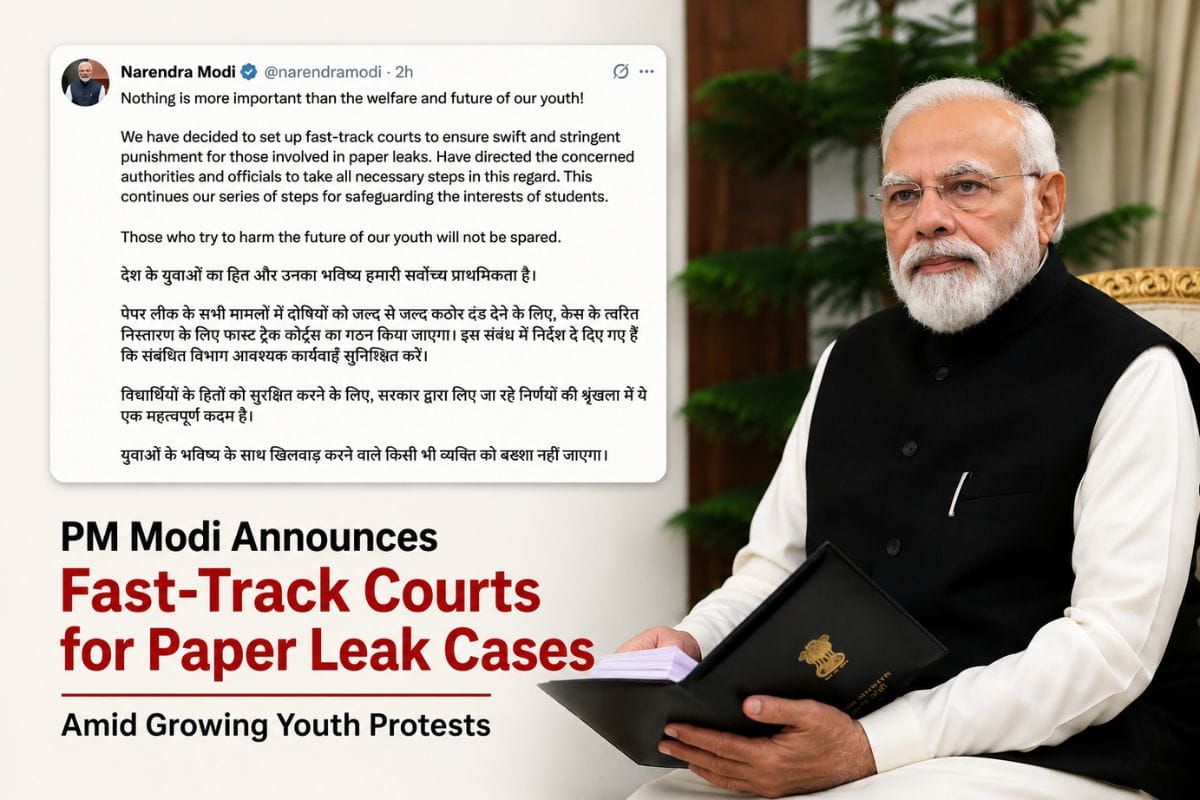
On Thursday, Prime Minister Narendra Modi announced that the central government has decided to set up fast-track courts for paper leak cases that will ensure speedy trials and harsher punishment for c culprits. Modi stated that a decision on this issue was more of an administration than a political one, and that the welfare and future of the nation’s youth was more important than anything else, in a post on X. He had said that the setting up of the fast-track courts had already been conveyed to the relevant authorities and that there would be no one to stop them from being taken action against if they interfered in the future of the country’s youth. The statement came on the day following the Prime Minister’s opening proclamation on the matter. It was his second public address on the matter in two days, amidst ongoing student protests country-wide.
Also Read More: CJP Jantar Mantar Protest Escalates As Rahul Gandhi

The announcement wasn’t a standalone. It comes on the heels of a week of growing unrest over the past few weeks, which has been spearheaded by a youth movement now one of the biggest threats to the government of Prime Minister Narendra Modi in his third term. The Cockroach Janta Party (CJP), a youth-driven satirical political outfit founded by Abhijeet Dipke, has been holding uninterrupted protests at Jantar Mantar, New Delhi, along with several student groups such as the Students Federation of India, the All India Students Association and the All India Students Federation. The protesters are protesting the resignation of Union Education Minister Dharmendra Pradhan over the alleged paper leak in NEET in 2026 and irregularities in the on-screen marking of CBSE exams, and call for reform in conducting public exams.
The name of the movement is a little strange, and it’s rooted in a statement by Chief Justice of India Surya Kant, who likened the jobless youths and social media activists to “cockroaches” and “parasites”. What started as an online joke turned into a massive offline protest. The scale of the underlying grievance is considerable: The NEET paper leak in May in a national examination for medical school admissions caused approximately two million students to sit the exam again, with several students reportedly taking their own lives as a result. According to separate reports, some 12 students committed suicide after the leaks, and the movement is also calling for financial compensation for every family concerned.
Also Read More: Dharmendra Pradhan’s First Reaction To Rahul Gandhi Protest
When a well-known public official became entangled in the protest, it fueled further momentum. On June 28, 2026, Sonam Wangchuk, a Ladakhi environmentalist and education activist, participated in the protest and initiated an indefinite hunger strike in Jantar Mantar demanding Pradhan’s resignation. He lost considerable amounts of weight during the 2-plus weeks of fasting. The situation turned violent when the police became directly involved in the protest. However, the student protests gained more attention in the national media because of the removal of barricades at the protest site by police officers following a change of leadership in Delhi Police in mid-July and the forced hospitalisation of Wangchuk when he was taken to the hospital against his will. However, the change of leadership in the Delhi Police office in the middle of July, when the officers removed the barricade from the protest site and forced the injured Wangchuk to hospital, while another incident of a woman shouting pro-Hindutva slogans at the CJP founder Dipke throwing ink, brought more attention to the student protests in the national media.
The protests escalated further as they tried to march on Parliament. Thousands took to the streets in protest on the first day of Parliament’s monsoon session, despite police efforts to disperse them with tear gas and baton charges. Still, CJP leaders said a Federal minister had assured the government that it would consider the protesters’ demands. The campaign, which had started only a few months ago, has already gained millions of followers on social media platforms and extended its reach to the opposition political parties, and some say it is the largest public opposition to Modi since he came to power in 2014.
Also Read More: Rahul Gandhi Protest Outside PM Modi’s Residence Sparks Fresh
The government has been minimally involved and very informal with the protest. A CJP spokesperson said the minister of health, J.P. Nadda, met the movement representatives at his residence and informed them that he would give them time to mull the demands, including the release of one of the detained activists and the resignation of Pradhan. Pradhan himself has strongly denied his resignation request, even going as far as to describe the protesters as a “B-team of terrorists” trying to fracture the nation in one televised interview, which Dipke strongly disagreed with. Meanwhile, protesters have charged police with using excessive force, such as tearing women’s clothes in the midst of clashes and beating some protesters badly.
In this context, the establishment of fast-track courts for paper leak cases announced on Thursday seems to be a display of government responsiveness but not an answer to the main political demand: Pradhan’s resignation. Paper leakage charges are not a new phenomenon in India, and it is not the first time that the state has resorted to fast-track courts for such cases. The country already has a law on the Public Examination (Prevention of Unfair Means) Act, 2024, and there are special fast-track courts which have been able to convict and sentence individuals, including a former Punjab and Haryana High Court registrar sentenced to five years in jail for leaking a paper in a judicial exam in 2017. In that judgment, the presiding judge remarked that paper leaks are usually a result of “organized rackets” involving coaching centres, exam-setting centres and printing presses, and recommended structural changes for the future.
It is still unclear if Thursday’s announcement will defuse the tension with the movement led by CJP. The party has already expressed its doubts on the fast-track courts, with some party members reportedly saying it was not enough, as their principal demand, that Pradhan resign, is yet to be fulfilled. The stand-off between the government and the youth-led Cockroach Janta Party movement doesn’t seem to be over, with the monsoon session of Parliament in session and protests continuing with large numbers in the streets of Delhi and elsewhere.

My name is Santosh Rana, and I am the Founder and Content Writer at Taza News, where I actively cover Education, Board Exam Results, Admit Cards, Government Jobs, Technology, and Breaking News updates. As the founder of the platform, I am committed to building a trusted digital news source that delivers accurate, timely, and reader-friendly information to audiences across India.