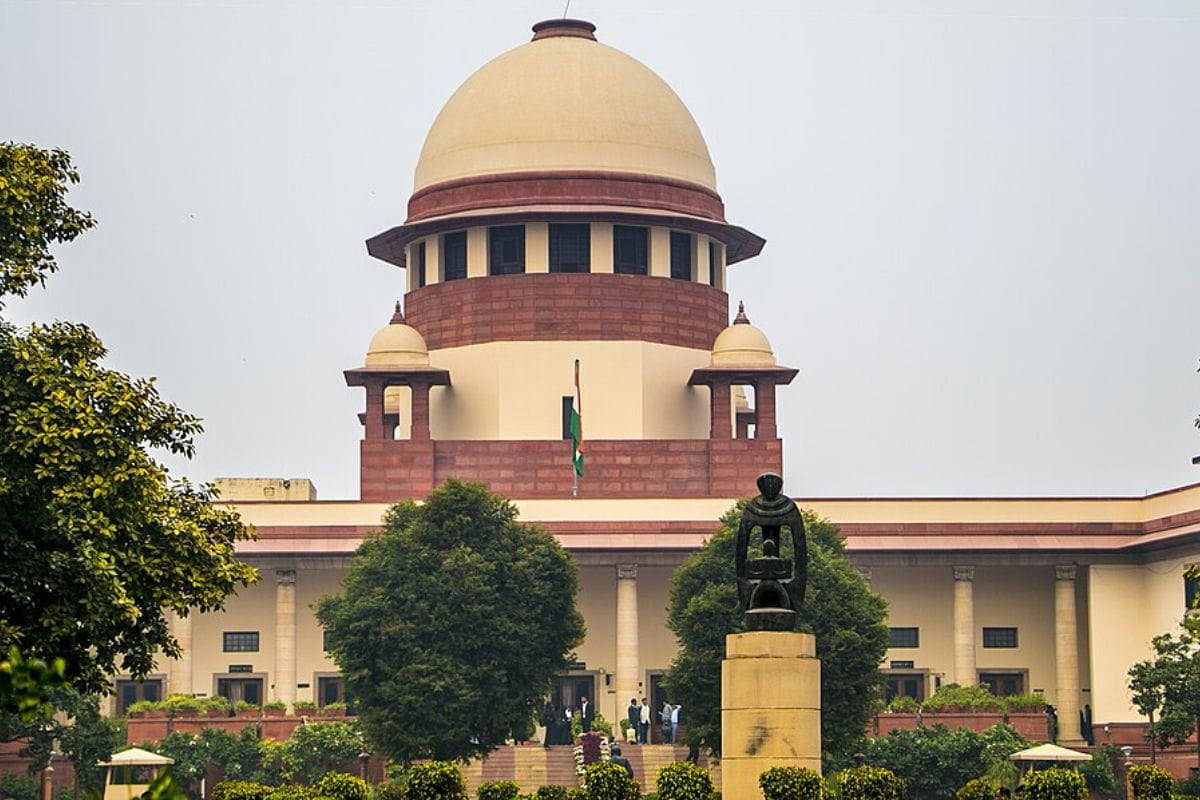
Supreme Court Extends: Section 498A now comes under the anti-cruelty law and women in such relationships are on par with legally married women in terms of legal protection. The judgment, issued by Justices Sanjay Karol and Nongmeikapam Kotiswar Singh of the Karnataka High Court on Monday, Aug 3, 2026, fills a much-needed void in the law, and women’s right to protection from cruelty does not depend on a formal marriage, irrespective of how marriage-like their relationship truly was.
The case went all the way to the Supreme Court when the accused had asked to set aside criminal proceedings filed against him, as there was no valid marriage between him and the complainant and therefore the provisions of the Indian Penal Code, Supreme Court Extends: Section 498A, could not be squarely invoked to prosecute him for committing cruelty by him and his relatives.

Also Read More: Kerala Rains Death Toll Rises To 15 As Seven Remain Missing
Traditionally, one of the most widely used provisions in criminal law in matrimonial proceedings is interpreted restrictively and applies only to marriage. The top court disagreed, and said that exclusion of women from protection in Supreme Court Extends: Section 498A of the Act in the name of absence of any formal ceremony would be an artificial and discriminatory distinction which is unrelated to the true intent of the law.
In its reasoning, the bench explained that the purpose of Section 498A was to offer protection where the woman is subjected to harassment or cruelty by a husband or in-laws through the commission of a wilful act, which causes mental or physical injury to the woman, or leads to her committing suicide. To claim that it could only happen in a “legally recognised” marriage, “would be a case of oversimplification”, said the judges. The court went on to say that the difference between a married woman and a woman living in a live-in relationship lacked a “rational nexus” to its purpose of preventing domestic violence and was “offensive to Article 14 of the Constitution of India” that ensures equality before the law.

Also Read More: SPO and VDG Honorarium Hike in Jammu & Kashmir 2026
This constitutional reasoning is what dovetails the ruling on live-in relationships of Section 498A and not any change in the language of the section itself. In its written observations, the bench also pointedly noted that “cruelty does not distinguish”, be it a house belonging to a formally married woman or not, and once it comes in, it “increases its destructive tendency.”
Perhaps most significantly, the Supreme Court didn’t give blanket immunity to all live-in partners. The definition of live-in relationships in Supreme Court Extends: Section 498A has been applied literally and only in cases where the relationship is found to be ‘like marriage’, and the intention to marry is intrinsic to that determination. The court relied on its own past judgments and that of two judgments in particular, namely D. Velusamy v. D. Patchaiammal (2010) and Indra Sarma v. V.K.V. Sarma (2013), which enumerated the tests to be followed for determining whether the relationship is at the marriage threshold or not, namely the length of the living together, sharing of a household, presenting themselves as a couple to the world and the stability and continuity of the relationship.
Judges cannot rely on any one of these alone and must consider the whole situation before deciding to extend the protection of Section 498A to a live-in partner of the aggrieved party, the court noted. This is a case-by-case procedure, officials and legal commentators say, which will ensure that the ruling does not become a blanket claim by all couples who are just living together without being married.
It has also been careful to confine the scope of its interpretation to IPC Section 498A alone and that this interpretation does not “impact any other provision.” That is, the judgment does not extend to the same rights as other laws relating to inheritance, maintenance, matrimonial property or any other rights, but only extends to criminal protection from cruelty.
The court also introduced a specific procedural safeguard to prevent the misuse of the expanded provision; it said that no person accused of cruelty in a live-in relationship “like marriage” can be arrested without a preliminary inquiry first being conducted, which is similar to the safeguard that already exists in the case of married couples under the existing Section 498A provision.
While hearing an appeal against the Karnataka High Court’s refusal to quash proceedings against the accused, the Supreme Court had struck down a provision in Section 498A that specified the relationship between the victim and the accused must be marital. In effect, the highest court has now put an end to the issue of “live-in relationships” in the country, as a point of law that was not uniform even among the various High Courts. It was noteworthy that the Kerala High Court came to a similar conclusion in a 2024 judgment that a woman’s live-in boyfriend could not be prosecuted under Section 498A.
According to the experts in the field, this decision is a move in the direction of the more “purposive” approach that the Supreme Court has taken to socially beneficial laws, which take into account the intent behind a law rather than a strict, literal interpretation of the text. The court recapitulated that its responsibility was “to ascertain the intention of the legislature and to interpret the mischief in such a way that the statute does not become meaningless” and that this meant the “husband” in Section 498A must be interpreted as “consistent with the underlying object of the statute” to protect people.
For women in live-in relationships throughout India, the judgment on the Section 498A live-in relationship is a huge and, somewhat limited, step forward in law, as it provides her with a way to defend against acts of cruelty, which, before this ruling, were only available for those who had a marriage license. Meanwhile, the protections that have been incorporated into the provision are supposed to prevent its abuse, and the court noted that the balance the protections strike is “central to the purpose of the ruling.”
I’m Pragya Jain, a content writer with 4 years of experience specializing in the Education sector. I have extensive expertise in covering exam results, government job notifications, recruitment updates, admit cards, answer keys, admissions, counselling, and other education-related updates. My content is based on official notifications and verified sources, ensuring every article is accurate, reliable, SEO-friendly, and easy for readers to understand.