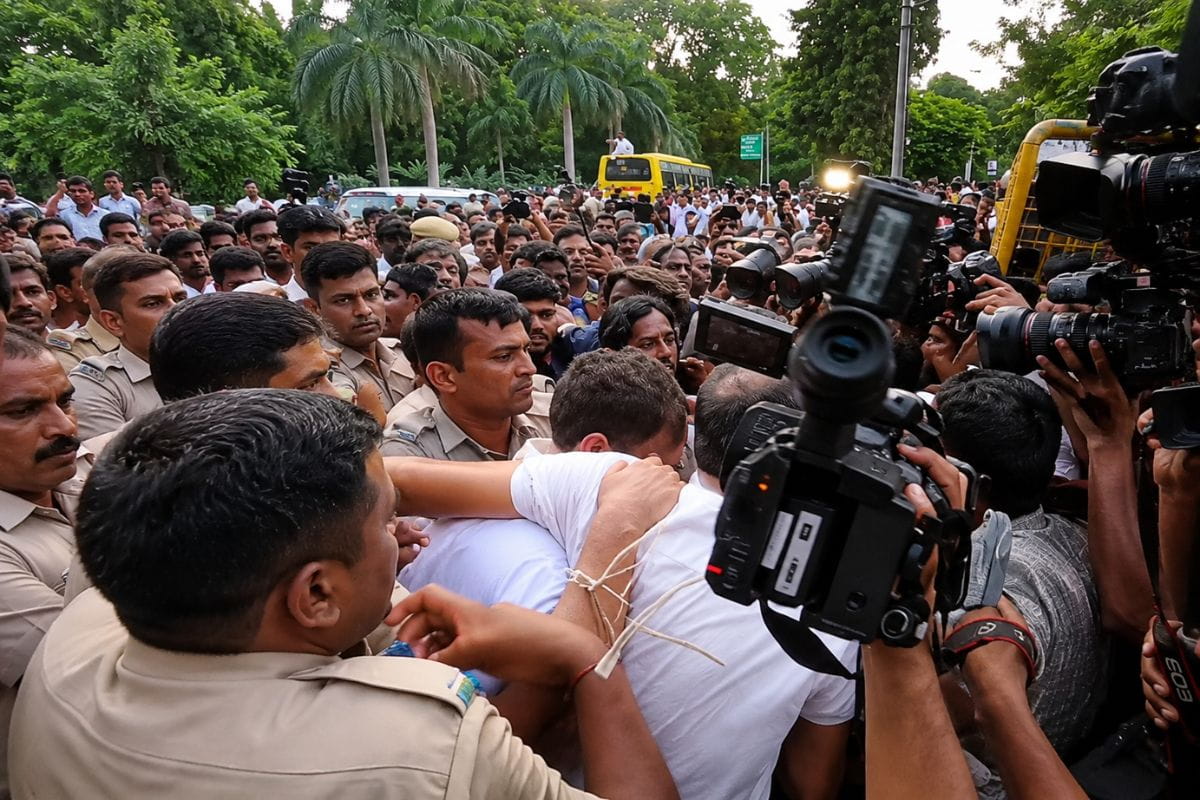
Rahul Gandhi’s protest outside PM Modi’s house is triggering a new tussle between the AAP and the Congress in the politically stormy week in Delhi. Rahul Gandhi, Congress chief Mallikarjun Kharge and Priyanka Gandhi Vadra staged a dramatic sit-in protest outside Prime Minister Narendra Modi’s residence on Lok Kalyan Marg demanding the resignation of the Prime Minister. The demonstration had started in protest over the police action at Parliament during the CJP’s march and quickly went out of control after the Delhi Police detained the Congress leaders, an incident that has now spiralled out of control between two parties who are nominally in the same opposition camp.
The immediate cause of the protest was the NEET paper leak controversy and the subsequent repercussions of the Cockroach Janata Party (CJP) agitation at the Jantar Mantar that has been ongoing for more than a month with the active participation of activist Sonam Wangchuk and CJP founder Abhijeet Dipke. The most important demand of the CJP has been the resignation of Union Education Minister Dharmendra Pradhan on the allegation of NEET paper leak. The CJP’s “chalo sansad” march towards Parliament in Delhi was met with force from the Delhi Police, who injured several protesters and hospitalised several, leading to tensions between the two parties. Reacting in quick response, Rahul Gandhi said that the central government’s action is “extremely arrogant” and a “crackdown on exercising the democratic right of students”. Union Minister JP Nadda then attended a hospital in Delhi to meet the injured protesters, and CJP leaders claimed that their members were virtually under house arrest while meeting the government.
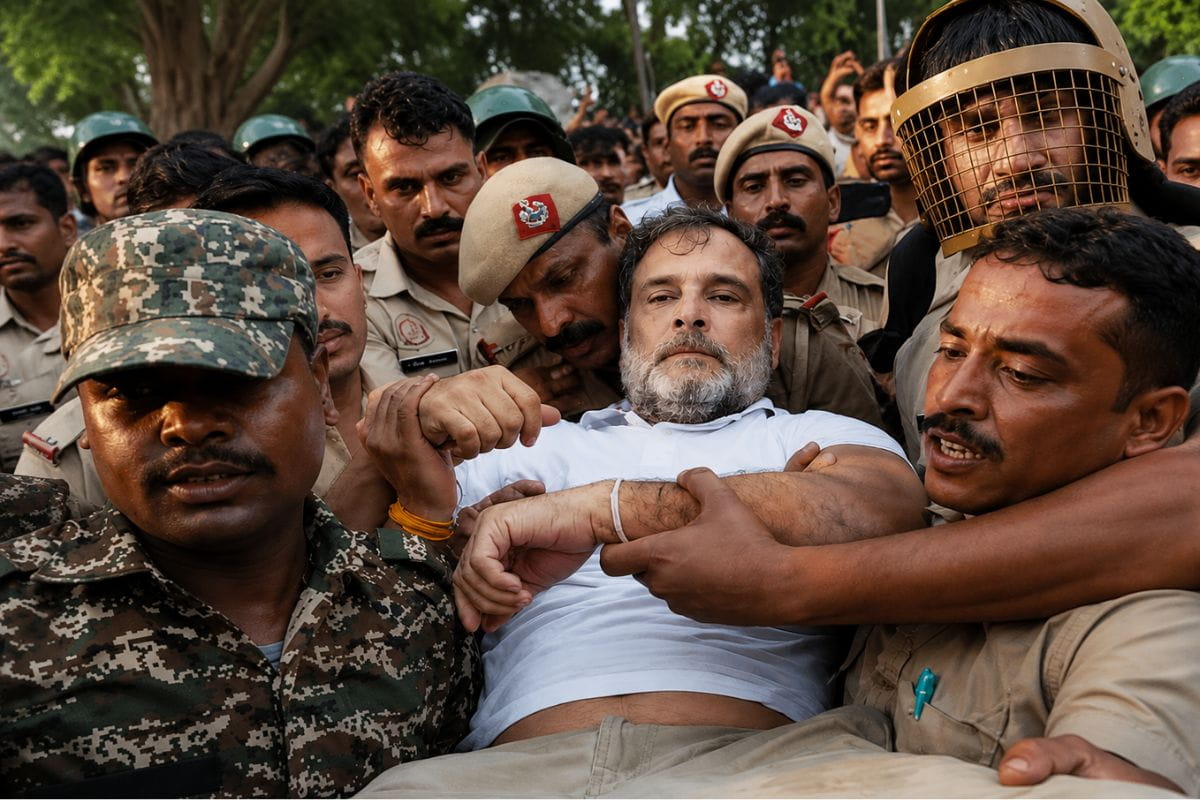
It was in this climate that the Congress protest march marched right past the Prime Minister’s home and Rahul Gandhi, Priyanka Gandhi, and Kharge held a sit-in protest demanding the resignation of Modi for the alleged police firing on CJP protesters. Congress leaders Rahul Gandhi, Priyanka Gandhi and others were arrested by Delhi Police during the protest. Rahul Gandhi was rushed to a stadium that was converted into a temporary detention centre and Priyanka Gandhi Vadra was detained at a police station for about three hours. Both were released later that evening. Rahul Gandhi, on his part, on being released, repeated his demand for a PM’s Parliament discussion on the NEET issue, placing yet another demand on the government over the paper leak controversy. Solidarity protests also resurged in the capital with AAP MPs holding a protest inside the Parliament complex against the police action, while former Maharashtra Chief Minister Uddhav Thackeray went to Jantar Mantar to support the protesters of the CJP.
What could have been a moment of unity for the opposition now turned into a caustic AAP-Congress row. It was supposed to be a moment of opposition unity but now became a sharp AAP-Congress row. Senior leaders of AAP alleged that Rahul Gandhi and the Congress were attempting to hijack and, in the process, weaken the month-long protest by the CJP at Jantar Mantar. The Delhi AAP chief, Saurabh Bharadwaj, had pointed out that the Congress leaders had garnered no support from the JNU while the protest was in progress and that the party was using social media platforms to weaken the movement. Sanji Singh, AAP Rajya Sabha MP, was more to the point, tweeting that the Congress had organised the dharna to “dilute” the protest of the CJP on social media.
Atishi, a former Delhi Chief Minister, took it one step further, contrasting the behavior towards the two protests. If CJP and Sonam Wangchuk are protesting for a month at Jantar Mantar and yet the government has not agreed to discuss the matter, and Rahul Gandhi can protest right outside the Prime Minister’s residence, then the government begins talks within an hour, she added. She also raised the question of how the same Delhi police was able to allow Rahul Gandhi to reach the PM’s residence in the midst of the CJP protest outside when they could not allow CJP protesters to come even a short distance towards Parliament, which indicated an unwritten understanding between the two national parties.
The Congress retaliated swiftly. Party leader Ragini Nayak lashed out at AAP, saying that “the party had revealed its true colours” when Rahul Gandhi asked for Modi’s resignation, taking a dig at AAP’s roots in the India Against Corruption movement.
The BJP had an opportunity to lash out at both opposition parties in the crossfire between the AAP and Congress. A senior BJP official accused the protests of being “anti-student” and said no student affected by the opposition was ever given a platform during any of the events, and opposition party leaders were only looking for political relevance at Jantar Mantar. He contended that the tussle between Congress and AAP over ownership of the moral high ground for the students’ issue proved that the protests were not `principled’ but politically motivated.
The episode reflects the complex dynamics of the opposition coalition in India, where the Congress and AAP (who were partnered in some States and were competing with each other in Delhi) have engaged in exchanges of jibes, but still, a government they both opposed. The CJP protest at Jantar Mantar, which is now in its second month, is demanding accountability over the NEET paper leak, and organisers say the government held talks while the police action against the protesters went on elsewhere.
The Congress had lined up the protest outside the residence of the PM ahead of their next parliamentary face-off with the government on the NEET issue as a demonstration of aggression against the government in front of everyone. But the quick AAP response indicates the optics were not working out as planned with an important ally, as the campaign against “police excess” evolved into a larger conversation about the unity of opposition, the media’s coverage and who does or does not have the students’ back.
Consequently, the CJP protest is still ongoing at Jantar Mantar while the AAP-Congress conflict hasn’t seen any de-escalation, and both are engaged in the political credit battle, not to mention the ongoing student issues regarding the NEET paper leak.

My name is Santosh Rana, and I am the Founder and Content Writer at Taza News, where I actively cover Education, Board Exam Results, Admit Cards, Government Jobs, Technology, and Breaking News updates. As the founder of the platform, I am committed to building a trusted digital news source that delivers accurate, timely, and reader-friendly information to audiences across India.