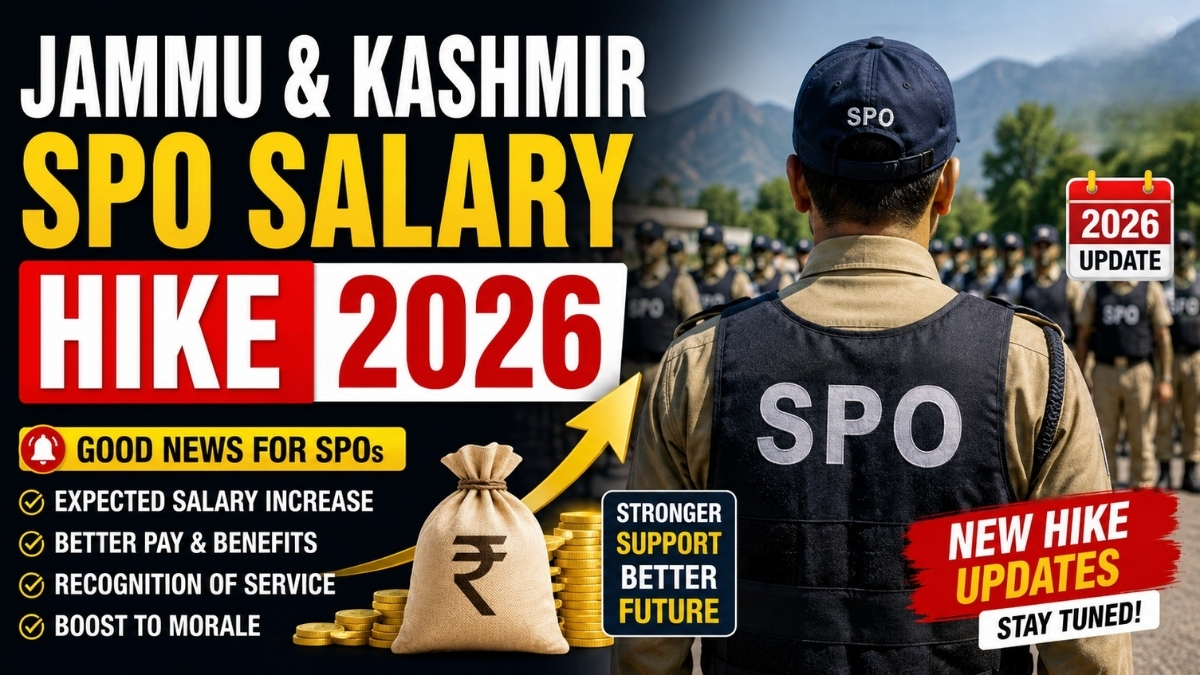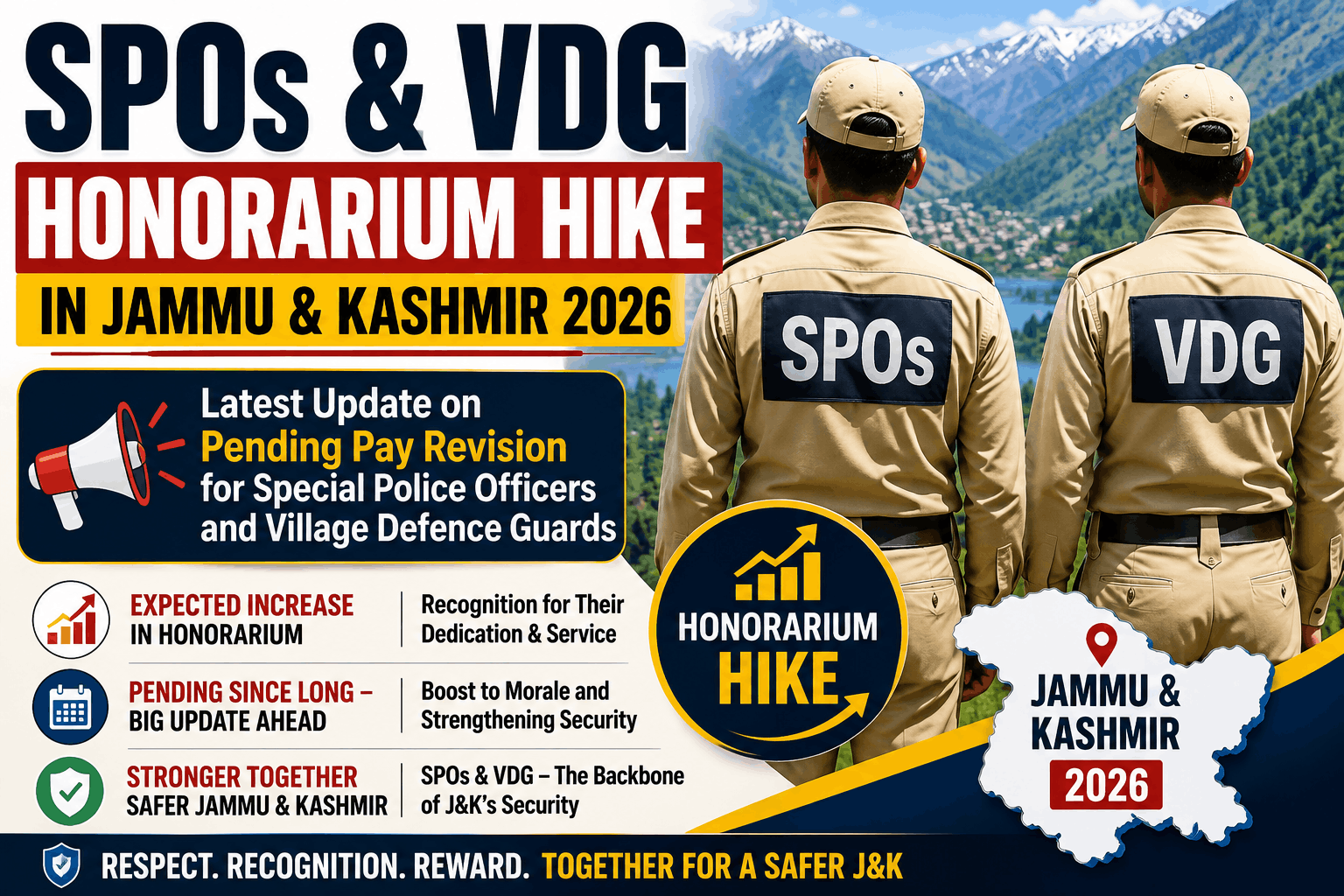
There is cautious optimism among the Special Police Officers (SPOs) and the Village Defence Guards (VDGs) of Jammu and Kashmir in 2026 after a long time, when the political discourse has shifted once again to their long-standing issue of job security and higher pay. Both groups have been demanding an increase in honorariums for years, as they have become the backbone of grassroots security in the Union Territory, which runs for Rs 1.5 lakh a month.
SPOs come under the police force of J&K and are appointed as part-time officers for station duty, counter-insurgency, deployment of law and order, and general security work with regular police officers. The number of SPOs in the Union Territory is approximately 32355, and in the past 20 years hundreds of them have died while on duty in militant attacks. They are currently paid by a slab with a range of ₹6,000 to ₹18,000, depending on the number of years of their service.
Also Read More: Kulgam Terror Attack
Reports emerged in January 2025 that the J&K Cabinet had revised this structure, with the pay for recruits being raised to ₹12,000, with a further increment to ₹18,000 after five years, ₹24,000 after 10 years and ₹30,000 for officers with 15 years or more of service. The announcement was widely broadcast, even on the ruling National Conference’s social media handles. But within days, it was brought under question as the claim comes from the Centre’s expenditure allocation scheme for security, which needs to be approved by the Ministry of Home Affairs, and not just a State Cabinet. The post was then removed, termed misleading, and the staffer in charge of circulating the post without verifying was fired. There is no notification or official gazette order confirming the revised figures, and thus the proposed slabs have not been implemented.
Also Read More: PM Modi Forgave Students
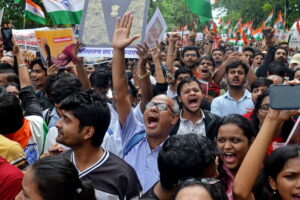
In parallel to this, the drive is to provide a formalisation mechanism for a regularisation process for long-serving SPOs, which would be related to years of service and to permanency. The concept is gaining traction, not just among one party or another, as SPOs have grown increasingly vital in sensitive areas in the day-to-day policing of Indian streets, but it is also waiting for a clear government directive.
The Village Defence Guards, on the other hand, are in a different but related position. VDGs are civilian volunteers who have received training in weapons handling and basic tactical drills and are deployed primarily in border and remote areas to enhance the preparedness of their local communities to respond to counter-terrorism threats, supervised by the district police. After being reorganized from the previous Village Defence Committees, the scheme was revived in 2022 and now has 4,153 groups in the Union Territory, with the highest concentration in Jammu province.
The honorarium for the members of VDG now ranges from ₹4,000 to ₹4,500 monthly. Later in late February 2026, the J&K BJP held a special meeting of the VDG Cell at the party headquarters in Jammu, where party leaders discussed the current honorarium as being woefully insufficient, considering that a lot of the VDG members belong to the economically weaker sections and that they could lose their BPL ration card benefits if they received the honorarium. The party formally asked for the honorarium to be increased to ₹18000/pm, in keeping with risks. Visitors also put other concerns it raised on the agenda: years of backlogged payments, differences in the level of insurance for VDRs as compared to regular police officers, calls for modern weapons and complaints that many eligible VDG members weren’t included in the 2022 restructuring at all.
Also Read More: Parliament Passes Vande Mataram Bill 2026
Both demands have been put before the Union Ministry of Home Affairs, as it is the Centre which funds these honorariums for the Union Territory. The existing pay scales will continue to be applicable (2018 slabs for SPOs and the average of about ₹4,000 per month for VDGs) until a formal notification is issued.
Political assurances and concrete orders for thousands of families who are relying on this income are a big deal in Jammu and Kashmir. Political leaders have termed them both ‘first line of defence’ in the security fabric of the area, and yet they have both been waiting for the ‘first line of defence’ to be converted into a signed, notified pay increase. In the meantime, the higher numbers that are being discussed – be it the SPO slabs of ₹12,000–₹30,000 or the announced rates of ₹18,000 VDG – should be seen as suggestions for discussion rather than guarantees of benefits.
Considering the sensitivity and longevity of the issue, any official statement will most likely be issued through a formal MHA circular or a J&K Cabinet notification, which are usually published on the Jammu & Kashmir Police Website and the Union Territory’s official website. With the way January 2025 unfolded, personnel and their families are reminded that they should trust these official channels and not social media posts for confirmation.
Understanding why this pay gap is so enduring is also important. SPOs and VDGs are positioned between regular police constables and army-backed local defence units: they perform duties similar to those of police constables or army-backed local defence units, but they are considered part-time, honorarium-based employees, not regular government officers. Despite reports on the ground that SPOs and VDGs are working the same high-risk operations as regular police staff, they remain excluded from the pay commissions and service protections afforded to regular police. The governments at Srinagar and Jammu have made several offers to fill the void, but the plans have stalled at the stage of approval of funds between the Union Territory government and the Ministry of Home Affairs.
The financial risk is also a reason for the delay. The Union Territory has more than 32,000 SPOs with over 4,000 VDGs in each of the Union Territories, and a modest increase in per-person cost translates to a significant yearly expenditure; any revision must be approved by the budgetary process before it can be notified. This is one of the reasons that the slabs from 2018 have served as the benchmark for almost eight years now, despite several increases being floated between them.
So, for the time being, the general word to the wise for SPOs, VDG members and their families is simply, carry on with the existing 2018 SPO slabs or the approximately ₹4000/per month rates being paid by VDG, and wait for an official circular issued by the J&K Police or from the Ministry of Home Affairs before confirming any increases in SPO rates. With the political spotlight now on the issue, from several quarters, it will not be surprising to see an entirely new set of negotiation efforts or an official order in the near future; for the time being, however, no such order has been issued.
Understanding why this pay gap is so enduring is also important. SPOs and VDGs are positioned between regular police constables and army-backed local defence units: they perform duties similar to those of police constables or army-backed local defence units, but they are considered part-time, honorarium-based employees, not regular government officers. Despite reports on the ground that SPOs and VDGs are working the same high-risk operations as regular police staff, they remain excluded from the pay commissions and service protections afforded to regular police. The governments at Srinagar and Jammu have made several offers to fill the void, but the plans have stalled at the stage of approval of funds between the Union Territory government and the Ministry of Home Affairs.
The financial risk is also a reason for the delay. The Union Territory has more than 32,000 SPOs with over 4,000 VDGs in each of the Union Territories, and a modest increase in per-person cost translates to a significant yearly expenditure; any revision must be approved by the budgetary process before it can be notified. This is one of the reasons that the slabs from 2018 have served as the benchmark for almost eight years now, despite several increases being floated between them.
So, for the time being, the general word to the wise for SPOs, VDG members and their families is simply: carry on with the existing 2018 SPO slabs or the approximately ₹4000/per month rates being paid by VDG, and wait for an official circular issued by the J&K Police or from the Ministry of Home Affairs before confirming any increases in SPO rates. With the political spotlight now on the issue from several quarters, it will not be surprising to see an entirely new set of negotiation efforts or an official order in the near future; for the time being, however, no such order has been issued.
Overview Table
| Particulars | Details |
| Scheme | SPO and VDG Honorarium Revision, Jammu & Kashmir |
| Administering Body | Jammu & Kashmir Police, in coordination with the Union Ministry of Home Affairs (MHA) |
| Total SPOs in J&K | Approximately 32,355 |
| Total VDGs in J&K | 4,153 Village Defence Groups, mostly in Jammu province |
| Current SPO Honorarium | ₹6,000 to ₹18,000 per month, based on the 2018 revision (varies by tenure) |
| Proposed SPO Honorarium (Unconfirmed) | Recruits (under 5 yrs): ₹12,000 5 years: ₹18,000 10 years: ₹24,000 15+ years: ₹30,000 Reported January 2025; later disputed and not formally notified |
| Current VDG Honorarium | ₹4,000 to ₹4,500 per month |
| Demanded VDG Honorarium | ₹18,000 per month (raised by J&K BJP’s VDG Cell, February 2026) |
| Official Confirmation Status | No MHA or J&K Government order has been issued as of 2026 |
| Official Website | jkpolice.gov.in |
| Other Official Links | https://jk.gov.in https://www.mha.gov.in https://jkpolice.gov.in |

My name is Santosh Rana, and I am the Founder and Content Writer at Taza News, where I actively cover Education, Board Exam Results, Admit Cards, Government Jobs, Technology, and Breaking News updates. As the founder of the platform, I am committed to building a trusted digital news source that delivers accurate, timely, and reader-friendly information to audiences across India.