NRI Fixed Deposit: Sending money home for investment is not an unusual practice for Indians who have gone to work or started a business overseas. A lot of NRIs prefer to park a portion of their foreign income within Indian borders safely, and this is precisely where NRIs can get to with their Fixed Deposit.
NRIs have a couple of options in terms of deposit accounts at banks, with the NRE fixed deposit being one of those options. Why? The interest that you could earn on it can be income tax-free in India, provided that the interest qualifies.

NRI customers are allowed to make deposits in two of the larger public sector banks, namely, SBI and PNB, in NRE. The amount of money that you can make depends on your time horizon, your amount of deposit and the bank’s interest rates at the time.
If you’re an NRI thinking about opening an FD in India, here’s a word of caution: don’t just chase the highest interest rate. Tenure, premature withdrawal rules, tax treatment, and what your money actually looks like at maturity all of that matters just as much.
So What Exactly Is an NRI Fixed Deposit?
It’s a term deposit facility made available to eligible Indian citizens living abroad. With an NRE FD specifically, money earned overseas gets routed through your NRE account and deposited in India.

Here’s the interesting part: even though the money originally comes from abroad, both the deposit and the interest are held in Indian rupees. And for eligible NRIs, the interest earned on this account can be exempt from tax in India.
That said, this exemption isn’t automatic. You need to qualify as a non-resident under FEMA and meet the applicable conditions. According to the Income Tax Department, this exemption on NRE account interest continues to hold under the current Income Tax Act, 2025 as well.
SBI’s NRE FD Rates
SBI offers NRE Term Deposits for its NRI customers, and like most FDs, the rate you get depends on how long you’re locking your money in and what the bank’s rates look like at that particular time.
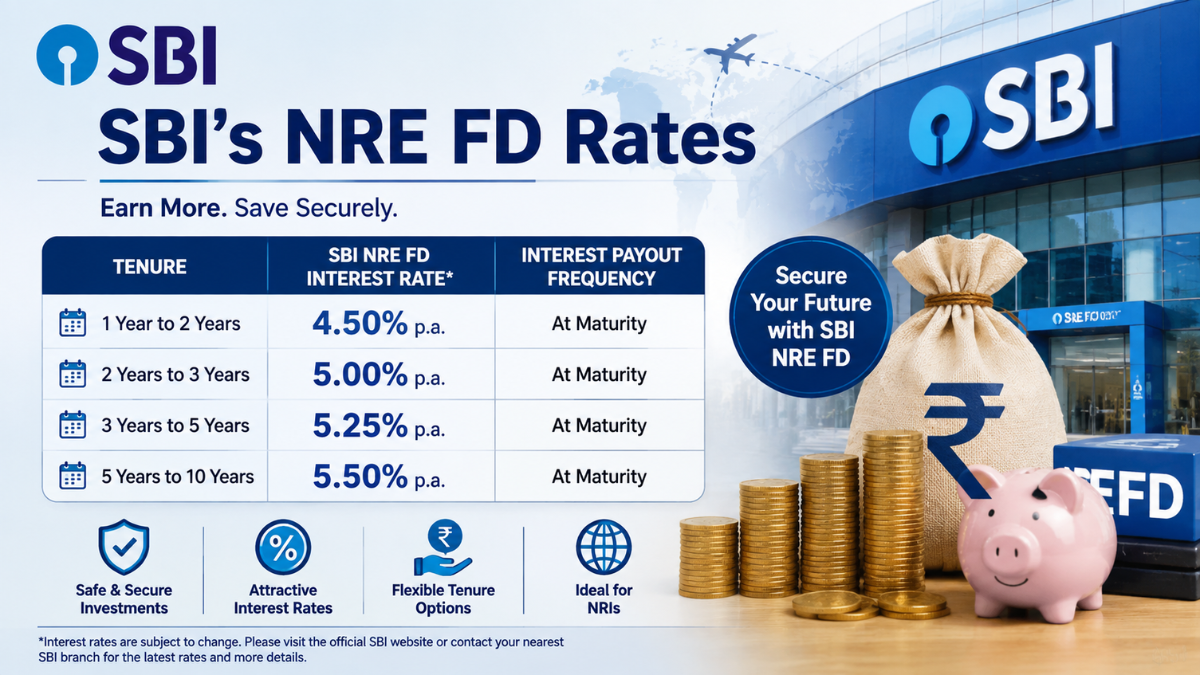
Given how often rates shift, it’s genuinely worth checking SBI’s official website on the day you’re actually opening the FD don’t go by numbers you saw a few weeks ago, because they may no longer apply.
Something else worth knowing: SBI’s various NRI deposit products NRE FD, FCNR(B), and so on don’t all follow the same rate or rule structure. It’s easy to lump them together, but they’re built differently, so it helps to understand each one on its own terms rather than assuming they’re interchangeable.
PNB’s NRE FD Rates
PNB also runs an NRE Term Deposit scheme for NRI customers. As per the bank’s website, the 444-day tenure is currently showing a rate of up to 6.60%. Keep in mind, though, that your actual rate will depend on the deposit category, tenure, and PNB’s applicable rate card at the time you book it.
The 444-day FD tends to get talked about a fair bit because its rate often looks better than several of the more standard tenures banks usually offer.
But here’s the thing worth remembering: picking an FD purely because it has the highest number attached to it isn’t always the smartest move. You also need to think about how long your money will stay locked away, and what happens if you need to break the FD early.
Why Does the 444-Day FD Get So Much Attention?
If you’re an NRI looking to park your money for roughly a year and a half, the 444-day option might fit that window nicely. Right now, PNB’s website shows this tenure at 6.60%.
That’s precisely why it tends to appeal to people planning short-to-medium term investments the timeframe lines up well for a lot of people’s plans. Still, don’t let the rate alone make the decision. Tenure, liquidity, and the fine print on premature withdrawal deserve equal weight.
How Much Interest Would You Earn on ₹5 Lakh?
Let’s say an NRI puts ₹5 lakh into a one-year FD at an assumed rate of 6.25%.
Simple math here:
₹5,00,000 × 6.25% = ₹31,250
So you’re looking at roughly ₹31,250 in interest over the year.
Add that to your principal, and your total comes to around ₹5,31,250.
This is merely an example number, nothing more. The type of deposit, how the bank determines interest, and whether you have selected a payout or cumulative option will all affect the actual maturity amount. Compounding will raise the final amount slightly over this straightforward estimate if it is cumulative and the interest is reinvested.
How Much Interest Would You Earn on ₹10 Lakh?
Now double that investment to ₹10 lakh, still at an assumed 6.25% for one year:
₹10,00,000 × 6.25% = ₹62,500
That works out to roughly ₹62,500 in interest for the year.
Which means, at maturity, you’d be looking at somewhere around ₹10,62,500 principal plus interest combined.
Again, this is based on an illustrative 6.25% figure. Whatever rate is actually live when you book your FD, plus the bank’s compounding method, will shape the real number you end up seeing.
Is the Interest on NRI FDs Taxable?
This is certainly the most significant attraction of an NRE FD – its tax benefits. According to the Income Tax Department, the income from the NRE accounts remains tax-exempt in India. However, and here’s the key, this exemption is only available to those who qualify. You actually have to meet FEMA’s requirements as a non-resident, and your NRE account has to be approved following RBI’s guidelines.
It’s incorrect to conclude that if an individual resides abroad, he or she automatically receives this tax benefit on interest earned by NRE FD. This is a big mistake. It’s never a bad idea to verify your residential status and FEMA eligibility before investing.
Do Senior Citizens Get Extra Interest on NRE FDs?
Many Indian banks offer senior residents a slightly higher interest rate on standard domestic fixed deposits. However, do not assume that this automatically applies to NRE FDs; NRIs do not work in the same way.

If you are an NRI senior citizen, you should look into your bank’s specific NRE deposit requirements before opening an account, rather than assuming the standard senior citizen benefit applies. In short, turning 60 does not guarantee that you will continue to be interested here. That is a domestic FD issue, but necessarily an NRE FD one.
Things Worth Checking Before You Open an NRI FD
NRI FDs are generally seen as a fairly safe investment, but there are a handful of things worth understanding before you actually put your money in.
1. Check the current interest rate
Look up the rate that’s live on the actual day you’re opening the FD. Banks revise their deposit rates fairly often, sometimes without much notice.
2. Understand the tenure options
Whether it’s 1 year, 2 years, or something like 444 days, the rate can shift quite a bit depending on the tenure. Pick based on when you’ll actually need the money, not just which tenure has the best number.
3. Read the premature withdrawal rules
If you end up needing to break the FD before maturity, banks have their own rules around this — usually a reduced interest rate or other conditions. Know this upfront so there are no surprises later.
4. Know the difference between NRE and NRO
These two aren’t the same thing, even though they sound similar. The source of funds, the purpose, and the tax treatment all differ between them.
5. Keep currency risk in mind
Since NRE FDs are held in rupees, if you’re earning in a foreign currency, exchange rate movement between that currency and the rupee is something you’ll want to factor in.
6. Don’t let the highest rate be the only deciding factor
A 6.60% FD isn’t automatically the better choice over a 6.25% one. If you know you’ll need your money back within a year, locking it into a much longer tenure even at a slightly better rate might not actually work in your favour.
SBI or PNB: Which One’s Better for NRIs?
Both are well-established and big public sector banks with good deposit facilities for NRIs. When you are looking for a bank to deposit your money in, it is obvious that you want to bank with a bank that you have confidence in. Therefore, it would be wise to compare the two banks’ current NRE FD terms side by side.
However, if you’re primarily interested in the better return, it would be more helpful to compare the returns of SBI and PNB by offering the same tenure, as it wouldn’t provide you with an apples-to-apples comparison.
Currently, PNB displays 6.60% for the 444-day tenure on its website. In either case, make sure to review the official rate card for the bank on the day you’re booking; FD rates move more often than expected.
A Practical Way to Choose Your FD
A decent approach is to weigh four things together, not one in isolation:
interest rate + tenure + liquidity + tax treatment
For instance, if you think you might need the money within the next 12 months, locking into a longer tenure just for a marginally better rate probably isn’t worth it. On the other hand, if the money isn’t going to be touched for a while, comparing rates across different tenures becomes a genuinely useful exercise.

My name is Santosh Rana, and I am the Founder and Content Writer at Taza News, where I actively cover Education, Board Exam Results, Admit Cards, Government Jobs, Technology, and Breaking News updates. As the founder of the platform, I am committed to building a trusted digital news source that delivers accurate, timely, and reader-friendly information to audiences across India.